The scene
opens to seagulls sailing through the sky, and as the camera pans downward
we see...desolation. Along the waterfront ruins of what was once Tomobiki,
a military tank sits quietly. Upon it Mendo, stripped to the waist, looks
over the shore through a pair of binoculars. Sakura, lying in the sun,
turns her gleaming eyes towards the sky. Megane and Perm, surrounded by
the comforts of home, apply sunscreen while music plays in the background.
Upon the waters, Lum, Ten, Kakugari and Chibi jetski, obviously enjoying
themselves. Lum calls to Ataru, who is standing knee-high in the water.
With a dazed look upon his face, Ataru stares at the ruins of Tomobiki
High School, which is partially submerged in the lake. And as its dead
clock begins to chime, Ataru remembers...
The
Beginning.
From above
the ruined clock tower (see "Only You") Tomobiki High School radiates
activity and enthusiasm as the students dash madly through the halls,
making final preparations for the coming of tomorrow's School Festival.
We turn our eyes to the Third Reich Decadent Teashop, run by the students
of Year 2, Class 4. Within, Mendo and the Stormtroopers are putting the
finishing touches on their WW2-Axis-Power-styled restaurant and wondering
where Ataru is. Onsen-Mark bursts in, demanding to know why the gang is
taking so long to complete their construction. Mendo asks Onsen to refrain
from stomping around as the weight of the Leopard Tank he brought could
cause the floor to collapse. Onsen is about to storm out when they hear
Ataru's voice emanating from the tank's cockpit. When Moroboshi mentions
Ryoko's name, Mendo leaps into the tank, intent on protecting his sister.
But Ataru, deep asleep, is alone in the Leopard, and Mendo's sudden arrival
causes him to bump the tank's control stick. The cannon swivels around,
catching Onsen-Mark in the chest and smashing its way through the adjacent
wall. Ryuunosuke, who was installing light bulbs from atop the Leopard,
also falls into the cockpit. As Onsen dangles outside the school, Lum
alights on the gun and asks him where Ataru is. Ignoring the teacher's
peril, she peers into the cockpit from the end of the cannon. Inside,
Ataru is scrambling after Ryunosuke. Lum shouts a warning into the Leopard
and counts to three. Everyone jumps away from the tank except Ataru and
Mendo, who are still fighting within. Lum then proceeds to electrocute
the tank, frying its occupants and activating its machinery. The Leopard
whirls out of control and destroys the teashop.
The principal
is very lenient, and the only punishment the gang receives is a long-winded
speech about the trials of youth while the tank strains at the ceiling
from above.
Lum and
Shinobu adjourn to the school kitchen where they meet Sakura, complain
about all the work ahead of them, and compare notes on men. Lum closes
the debate by explaining her dream: to forever live on Earth with Ataru,
his parents, Ten, Mendo, Megane, and all their friends. Since this is
a close description of her life in reality, she is immensely content.
Having
concluded their meal, Ataru and Mendo leave a Beefbowl shop and drive
towards the school. Mendo is still upset about the incident with the tank,
and Ataru wonders why the town is so quiet tonight. After stopping at
an intersection to wait for the light, a mysterious special-sale band
(followed by a small girl in a summer dress ) dances across the street,
playing a haunting melody. After they disappear into the night, the car
drives off, while the boys wonder at the sight they have just witnessed.
The
Beginning of the End.
As the
day begins, construction at the high school continues for the coming of
the School Festival. The gang brushes their teeth together while complaining
about all the work they have yet to complete. Lum encourages them, reminding
everyone that there's only one day left to go. Then they watch as Onsen-Mark
drags himself across the grounds, marveling at how exhausted he looks.
In the
infirmary, Sakura diagnoses Onsen with overwork and insists that he return
from to his dormitory and sleep until evening. She also prescribes some
tranquilizers for his nerves.
So begins
the day after the day before the School Festival, which is also the day
before the School Festival. The events of today closely mirror the events
of yesterday, with a few minor variations. From an empty classroom, the
Child from the special-sale band watches the activities through an open
window.
Back in
the infirmary, Sakura is tending to the numerous casualties of the day's
construction. When she comes to a patient suffering from indigestion,
she prescribes super-high-potency laxatives. Unfortunately, the bottle
she passes him turns out to be Onsen-Mark's tranquilizers, which means....
Sakura
tears across the streets of Tomobiki on her motorcycle, making a beeline
for Onsen's apartment house and praying that she is in time. She bursts
into his second-floor flat shouting a brief warning, only to loose her
footing on the slimy floor. Onsen-Mark's apartments are in ruins, with
a foot of dust covering everything and mushrooms growing on the walls.
Onsen, clearly out of it, is sitting in the middle of the room watching
a grimy television. Sliding past his position, Sakura grabs him by his
shirt and swings him out the window. After taking a few seconds to catch
her breath, she realizes her mistake and hurries outside to catch Onsen,
but abstains when she realizes how grungy he is.
In a small
cafe, Onsen-Mark and Sakura discuss the situation. It seems that Onsen
has lost all track of time, and is losing his ability to remember the
past. It is his opinion that Tomobiki has become caught in a time-loop,
citing the story of Urashima Taro as an example. Sakura is convinced that
it is only a product of his overworked mind, and continues to reassure
him as they return to the high school. From the gate they watch as Kakugari,
hanging from the end of the Leopard's cannon and crying for help, explodes
through a second-story wall.
Onsen
has had enough. That night, he closes the school and refuses to allow
the students to sleep there as they have throughout the project. Deaf
to the pleads of his charges, he tells everyone to go home. He also dismisses
the staff, emptying the building save for the Fujinamis in their teashop.
Everyone goes their separate ways. Lum flies home with Ataru, and Shinobu
accepts a ride home from Mendo. Perm and Megane take a train, while Kakugari
and Chibi leave in a bus. Sakura walks off to find Cherry.
Mendo
and Shinobu find that all roads seem to lead to Tomobiki High, the train
Megane and Perm took loops back on itself, and the bus dumps Kakugari
and Chibi back in front of the school. Meanwhile, Cherry has disappeared.
His kettle, normally overflowing with garbage stew, runs over with rainwater,
and stray cats are the sole occupants of his tent. After failing to locate
him, Sakura attempts to contact Onsen-Mark but there is no answer at the
school. She hails a cab, and the return trip takes an unusually long time.
When Sakura questions the driver, he launches into a long discussion about
the nature of time, invoking Urashima Taro and making allusions that sound
suspiciously applicable to the current situation. Sakura grows suspicious
and pulls a spirit wand on him, at which point the taxi swerves out of
control and comes to a halt in front of the school building.
Since
they can't get into the school, and they can't get out of town, the gang
heads for Ataru's house and humbly asks for lodging, much to his annoyance.
The cast tries to phone anyone outside of Tomobiki, but there are no responses.
Sakura heads upstairs to discuss the situation, but all the men (save
Mendo) are too busy tearing Chibi apart.
Meanwhile,
Shinobu visits Lum and Ten in another room. Ten has recently acquired
an ultra-cute piglet which he is keeping as a pet. The next morning, our
cast eats breakfast and prepares for the day before the School Festival
(again), and while Ataru and Co. are royally pigging out, Ten's piglet
is curiously lacking in appetite.
Heading
for school, the gang heads down a street strewn with puddles from the
previous night's rain. After Ataru accidentally steps into one and sinks
out of existence, Lum flies off to find him. Shinobu, bringing up the
rear, passes by an alleyway when she hears the odd tinkle of a windchime.
Looking into the alleyway, she is startled to find herself lost in a universe
of endless alleyways and tinkling windchimes, accompanied by the brief
appearance of the Child turning from one passage to another. The vision
fades and Shinobu is alone on the street she was traveling.
At Tomobiki
High, Mendo's tank has somehow been relocated to the school's swimming
pool. While Mendo stares blankly, Ataru suddenly appears inside the pool,
unaware of how he arrived. Mendo blames Ataru and starts chasing him through
the pool, breaking his katana in the process. Things get worse when Lum
arrives, and when Ataru refuses to come out, she gives her "One,two..."
warning and electrocutes the pool. From her infirmary window, Sakura watches
the scene and resolves to inform the restof the cast as to the nature
of their problem.
Eating
dinner at a pancake shop, Sakura and Mendo attempt to explain the scenario.
Ataru, Megane, and the Stormtroopers seem relatively unconvinced, regarding
the disappearances of Cherry and Onsen-Mark as blessings rather than mysteries
to be solved. It is only when Mendo refuses to pay their check that they
agree to investigate further. Since everything seems to revolve around
the school, the gang returns to explore it. They split up, only to find
that things make even less sense inside the school than they do outside.
Ataru gets caught in a room where he chases infinite images of himself.
Lum flies aroundlooking for Ataru. Mendo keeps running up stairs that
don't lead anywhere waving around his newly regenerated katana, and things
really get strange when Kakugari and Chibi try to turn on the lights.
Finally, the gang retreats, falling out of a window when the floor they're
running on turns out to be the ceiling.
Mendo
decides to take action. At his direction, Sakura drives the gang to the
Mendo Family Tomobiki Panic Center, also known as Mach Speed Noodles.
In its secret basement, Mendo boards a Harrier, planning to fly to the
Mendo Estate and send helicopters to recover the rest of the group. However,
Ataru and Co. aren't willing to be left behind, and climb onto the plane
from all sides. Mendo merely shrugs and initiates a vertical takeoff.
As the plane escapes the city limits, the Harrier's passengers are entreated
to a bizarre sight. Tomobiki is riding on the back of a massive stone
turtle that flies through the night sky. Flying in for a closer look,
we see that the town's plate is actually supported above the turtle's
back by stone columns that bare an extreme resemblance to Onsen-Mark and
Cherry. Suddenly, the plane begins to sputter. Although they have only
been flying for a few minutes, the Harrier has suddenly run out of gas.
Having no other option, Mendo makes a forced landing at the Moroboshi
residence, where the gang requests further lodging.
The
End
The loop
has ended, and to Megane's point of view, so has the world. The circumstances
of our apocalypse are strange indeed. Within a night, the entire population
of Tomobiki has disappeared, save for the members of our cast. All buildings
not of value as sources of supplies or entertainment crumble to dust,
leaving a scarred yet beautiful landscape. The convenience store near
Ataru's house seems to have an infinite food supply in stock, and it becomes
the central provider for the gang's needs. Further, the gas, electricity,
and water supplies all continue uninterrupted at the Moroboshi residence.
The morning paper (of which Ataru's father is so fond) also continues,
though there would seem to be little news to report. Everyone copes with
the new world in their own way. Sakura opens a beefbowl restaurant, and
the Fujinamis reestablish Hama Teashop. Mendo drives around in his tank
all day, blasting at the ruins of old buildings. Megane writes long inspirational
speeches about the rebirth of mankind. Having nothing else to do, the
rest of the gang settles down to enjoying itself. Picnics, rollerskating,
movies, trips to the lake (which now surrounds the wreckage of the old
high school) and fireworks shows become the daily routine. After a brief
period of time, Shinobu and Ryuunosuke disappear inexplicably, and no
amount of search by the gang can locate them. On a hunch, Sakura has Mendo
examine the underside of Tomobiki's platform and, sure enough, stone pillars
in the shapes of Shinobu and Ryuunosuke have joined those of Cherry and
Onsen-Mark.
Fearing
for her own continued existence, Sakura sends Ataru an invitation to meet
her alone at the high school's clock tower after sundown. At the appointed
hour, Moroboshi arrives to be greeted by a dressed-up Sakura...and the
end of Mendo's katana. It seems that while everyone else was busy partying,
Mendo and Sakura were attempting to decipher the nature of their world.
This world is all too convenient, and the existence of such a world is
physically impossible. Since it DOES exist, then it must be a dream. Ataru
replies that he and the Stormtroopers had figured that out a long time
ago, but dismissed it as being too obvious an answer. Further, it is an
irrelevant point since they don't know whose dream it is. Mendo knows.
By use of simple logic, he quickly eliminates everyone in the dream except
Lum, who seems to be the one most convenienced by their situation. Ataru's
counter for this is Lum wouldn't delete the missing characters, which
should show that she is not responsible for the world's existence. It
is at this point that Sakura interrupts the debate. Both Ataru and Mendo
are correct, but her analysis includes an option they ignored: that a
third party created and has been maintaining this world for Lum's use.
She concludes by accusing Ataru of creating this world. His retort is
that a mere high school student couldn't possibly do that. Sakura cuts
off his protests by calling into the next room...and inviting Ataru in.
Sakura chides the impostor for ignoring Ataru's thought processes--the
real Moroboshi made a beeline for Sakura the moment he received her message.
Suddenly, a fence composed of hanging Shinto streamers pops out of the
water, trapping the fake.
With a
bang, the fake Ataru reverts to his true form. It is the demon Mujaki,
a dream spirit responsible for the twisting of humanity by giving them
evil dreams. Mujaki argues that he only provided the dreams his clients
desired, and that many of them were good dreams...initially. Given time,
they evolve into nightmares and are finally eaten by Baku. Becoming depressed
with creating dreams only to see them destroyed time after time, he decided
to retire. It was at that point that he encountered Lum.
To illustrate
Mujaki's story, a scene forms over the waters of the lake. We see how
Mujaki found Lum at an aquarium, still recovering from her latest bout
with Ataru. Entranced, he opened a dialogue with Lum, eventually asking
her to describe her dream for his retirement project--the creation of
an eternal dream world. Lum replies with the line she delivered at the
beginning of the movie: to forever live on Earth with Ataru, his parents,
Ten, Mendo, Megane, and all their friends. And so it was.
Having
concluded his tale, Mujaki escapes by using the aquarium scene as an exit
point. Sealing his would-be captors inside one of the fish tanks, Mujaki
waltzes off, chiding them for their naievity. He goes on to reveal that,
in exchange for supporting his world, the missing characters are provided
with dreams of their own. Cherry eats mountains of food, Ryuunosuke swims
in feminine clothing, Shinobu marries Mendo, and Onsen-Mark enjoys a quiet
dinner with his wife. Having disposed of Ataru, Mujaki plans to replace
him and enjoy eternity with Lum.
At this
point, Mujaki runs into Ataru. It seems that during his aquarium scene,
Ataru jumped at Mujaki's image when it approached Lum, and fell into the
water. It was in this way that he was able to avoid being sealed in with
Sakura and Mendo. Mujaki is ready to lock him up until Ataru, waving a
spirit wand Sakura gave him, suggests an exchange: he'll go quietly if
Mujaki creates his ultimate dream.
In his
newly established harem, surrounded by half-nude women, Ataru enjoys himself
until he realizes that Lum isn't among the various lusts begging for his
attention. Mujaki is confused by Ataru's protests, since he was always
running from Lum. Ataru, amused by Mujaki's misunderstanding, explains
what we always knew. He is in love with Lum, just as he is with all the
other women, and that the reason why he was always running was because
she was trying to tie him down. Having explained himself, Ataru goes on
to demand Lum's appearance, else he will destroy the dream and return
to reality. Outraged, Mujaki dares him to do so, accidentally dropping
a small bugle. He then compounds his error by explaining its ability to
summon Baku. Desperately, he begs Ataru not to use it, asking him to consider
the consequences of the dream's collapse. Ataru, of course, never thinks
about the consequences. Taking a deep breath, he blows a morning call
to everyone within a hundred miles.
At the
Moroboshi residence, Ten's piglet suddenly awakens, its eyes shining in
the dark. Leaping into the darkness, dumbo ears supporting its flight,
it swells to gargantuan proportions and takes to the world like a vacuum
cleaner to carpet. Everything that falls beneath his mouth is decimated
and consumed: the land, the sky, and the school. Just before the dream's
turtle shatters, Mujaki refuses to allow Ataru's escape.
Chaos
Ataru
awakens in Mendo's car, just after leaving the beefbowl shop. Relieved
by his escape, he discusses the nature of dreams with Mendo, at which
point Mendo's driver reveals himself as Mujaki. Frustrated, Ataru slams
his skull into Mujaki's, causing them to crash into a wall.
Ataru
awakens to the sound of his mother's voice...and those of everyone else
on earth. He's back at the beginning of the series, just after being knocked
out during his game of tag with Lum. With only ten minutes left, Shinobu
reminds him of their marriage upon his victory. Determined, Ataru whips
out Lum's bra, preparing to grab her horns....and hesitates. Everything
began after he grabbed Lum's horns, and----but time has run out. Cursing
him, Mujaki and the townspeople mob Ataru and begin stomping him into
the ground.
Ataru
awakens as Frankenstein's monster. Hated by the people, he walks alone,
until the Child appears and offers him a dandelion. Then Mujaki, in german
villager garb and brandishing a rifle, intervenes. The two rush at each
other, and Mujaki shoots Ataru while Ataru clubs him over the head with
his Frankenstein mask.
Ataru
awakens in a futuristic laboratory. A recording of his father's voice
begins to play, stating that he and Lum had fallen prey to diseased sleep
that the sciences of Earth and Urusei were unable to cure. Placing their
hopes on the future, their parents had them placed in cryogenic suspension
for five-hundred years. But when Ataru examines Lum's coffin, he finds
the wires torn and burnt. An nearby display states that an emergency occurred
four-hundred years ago and calls for "immediate assistance". From a side
view, we catch a brief glimpse of Lum's corpse before Ataru, horrified,
runs headlong into a wall...
...and
through it. It was one of Mujaki's dream constructs, just like all the
others. Mujaki, yelling at Ataru for breaking out of his dreams before
he has time to set up new ones, clubs him over the head with a wooden
mallet.
Ataru
floats on a strand of DNA while Mujaki tries to talk him out of resisting.
He argues that since there is no perceivable difference between his dreams
and reality, they are reality to the dreamer. This being the case, isn't
it better to enjoy oneself in the world of dreams? Mujaki goes on to offer
Ataru endless vistas of dreams in return for his cooperation. As Ataru
mulls over his position, he is approached by the Child who asks him if
he is truly serious about returning. She then directs him to jump from
the dream, and call the name of the one person he most wants to see before
he hits the ground. This seems simple enough to Ataru, as there are lots
of girls he wants to see. The strand he's sitting on collapses, and just
before the dream fades we catch sight of Lum's face beneath the Child's
sunhat.
Catapulted
away from Mujaki's subaquatic dream realm, Ataru is hurled into the air
over Tomobiki High School. As he falls toward the ground, he calls the
names of every girl in Urusei Yatsura, including his mother. At the last
possible second, he calls for Lum, falling through the school's ceiling.
A New
Beginning
Ataru
passes through the roof and third floor without harm, landing facefirst
on the floor of the gang's teashop. At the end of the room, he sees himself
sleeping on a pile of boxes near Lum. Enraged, he yells at himself for
sleeping so long and kicks the stool out from under his head.
Ataru
falls to the floor with a crash. Picking himself up, he takes a good look
around the room. Everyone is snoozing quietly in the morning light. Turning
an eye towards Lum, he watches her peacefully as the chiming of the clock's
tower brings her awake. Lum turns to Ataru, describing her bizarre dream.
He shushes her, reminding her that it was only a dream. They are about
to kiss when the rest of the gang, awake and livid, coughs loudly. This
stops Ataru since he doesn't want to be seen kissing Lum. An argument
ensues...
Outside,
some workmen are putting the final touches on a banner above the main
entrance when a window explodes outward electrically. They comment on
how they never seem to change, and how those two will continue for the
rest of their lives. Mujaki agrees. Detaining that pair takes much more
work than usual.
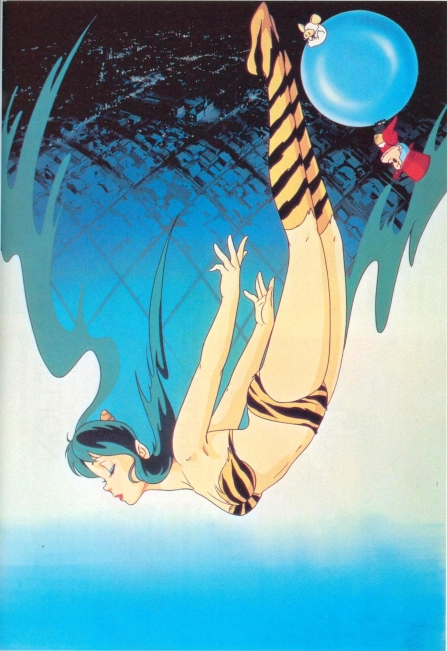
Urusei Yatsura 2: Beautiful Dreamer (so named because it was the second theatrical Urusei Yatsura film) originally ran in Japanese theaters beginning February 11, 1984. Like the first, it was directed by seasoned anime veteran Mamoru Oshii. Oshii decided that the previous film, Only You, had been too much like the source comics and used aliens to drive the story. He wanted to write a story driven solely by the high school students.
The story is at least partially inspired by an earlier Urusei Yatsura story, the second part of TV episode 21: "Wake Up to a Nightmare."
Toho Galore - Among the costumed students preparing for the festival at Tomobiki High, one can see a number of Toho-based characters. Beautiful Dreamer is the only film in the series produced by Toho Co., Ltd. In an interview circa 2004 with Central Park Media's John O'Donnell and Masumi Honma, Oshii offered this insight when asked about these characters, and the later Godzilla sequence:
"The Toho people were thrilled. There weren't too many videos during that time, so for that scene the animator had to draw that segment from Godzilla almost entirely from memory. They even drew in the static, and tried to replicate the old scratched-up film, so they put a lot of effort into it."
Incidentally, the newspaper article in the movie says Gamera wants another chance too is likely a nod to the fact that Toho was in the process of rebooting Godzilla at the time.
An Uneven Split - When Urusei Yatsura 2: Beautiful Dreamer was first licensed in the US in the 1990s it was done so by Central Park Media (CPM). However, friendly market competitor AnimEigo released the rest of the Urusei Yatsura series and feature films. So why the unique release? In Robert Woodhead's (of AnimEigo) own 1998 words:
"CPM picked up (Beautiful Dreamer) from Toho. We licensed everything else from Compass (sublicensed from Kitty Films). Toho only had the rights to (Beautiful Dreamer). Neither CPM nor AnimEigo knew the other company was discussing (Urusei Yatsura), so things sort of "crossed in the mail". John at CPM figured "I'll pick up (Beautiful Dreamer) and then go to Kitty to get the rest" and I figured "I'll pick up everything but (Beautiful Dreamer) and then go talk to Toho!" When we discovered what happened it was obviously good sense to harmonize the pre-production, so AnimEigo did the translation and titling, and CPM did the basic package layout, which we then used on all the other tapes."
Momotaro, Manchuria and Genghis Khan...?
"Momotaro can go to Manchuria and become Genghis Khan." - The Principal is scrambling different legends here. Momotaro is a famous Japanese legend about a boy who was found inside of a peach by a childless couple and soon became a warrior.
It's since been pretty well debunked, but Japanese hero Yoshitsune Minamoto was once suspected of escaping Japan, and a vengeful brother by building the Mongol Empire as a new identity, Genghis Khan. The Principal's quotes form Goethe and Shinran the monk are probably inaccurate, too.
"When did special-sale bands start working the night shift?" - Chindon'ya are Japanese marching bands generally employed for the purpose of promoting businesses and services. Chin and don are approximations of the instruments' sounds, so the name could literally translate as "Clang-n'-Thumpers." Wikipedia reports that they have been in decline for decades and were even banned (along with all street performers) in many large cities as far back as 1970.
Da Capo Classical Music Cafe - Classical Music Cafes (Meikyoku Kissa) were regular Japanese coffee shops or cafes that played classical music all day. They rose to prominence during the 1950s and 60s, a time when a varied LP record collection was not affordable to the average person. As records became cheaper after the 1960s, classical music cafes went into decline. Da Capo is a musical term that means to "go back to the start," a subtle reflection of the unfolding tale. A type in the background painting led this to be translated as "Da Carpo" in past releases, but we assure you, it is not a Classical Fish Cafe. Many of the other places and things are jokes. For example, Tentama at the noodle stand is likely a nod to Tenshi no Tamago (Angel's Egg), which Oshii worked on around the same time.
Mother-In-Law-To-Be - Lum calls Mrs. Moroboshi Okaasan, or Mother in Japanese. This is thanks ot her engagement to Ataru which kicked off the series. She treats Ataru throughout the series as if they are already married (advances Ataru angrily rejects), and this extends to how she addresses her would-be in-laws.
The scene of Shinobu in the alleyway with the windchimes ends with a figure seen from behind looking out a window. When asked about who this character is and if it was Ataru, director Mamoru Oshii stated, "It’s the viewer, one’s self. It could be that the animator or colorist thought it was Ataru as well. But the guy is someone outside of it all. I like the idea of briefly showing someone removed from the situation."
In the scene with the late night street musicians (ちんどん屋) there is unique music that is played that is not found on the soundtrack to the film. When asked, it was stated that Shigeharu Shiba, the sound director, did not feel like the music fit the LP and swapped it for an unused song that had been intended (but not used) for Sasuga no Sarutobi (さすがの猿飛). You can hear a live, fan-made recording of the song in question.
Butsumetsu First District (Unlucky Day District) - On the Japanese calendar, the days of rokukyoh are 6 repeating days, aligned with the Chinese calendar. Rokuyoh are used to determine which days are to be most fortunate, though they are mostly used for planning weddings or funerals. The days are senshoh, tomobiki, senbu, butsumetsu, taian, and shakkoh. Urusei Yatsura fans will most readily recognize Tomobiki, the name of Ataru and Lum's town and high school. Tomobiki's forecast (appropriate for Urusei Yatsura) is that "bad things will happen to your friends." Funerals are ill-advised on tomobiki ("friend-pull") days because friends might be "pulled" toward the deceased. A neighboring rival school packed with ruffians and thugs adopts the rokuyoh day butsumetsu. Butsumetsu is symbolic of Buddha's dying day, and it is considered the most unlucky day. The "Butsumetsu First District" sign is a nod to this.
Misleading Mujaki - Mujaki's name, when read as written, can mean "innocent," but when written with different characters, it can also be read as "Dream-Eating Demon," hence Sakuras accusation.
As for Baku, there is a Japanese myth that says that Baku is the name of a monster that feeds on nightmares.
Urashima Dreamin' - Like many other creative works before and following Urusei Yatsura, much of the film's concept is inspired by the folk tale of Urashima Taro. Taro's tale has a lot in common with the Washington Irving story Rip Van Winkle, and the folklore which had inspired it. A brief summary follows for those unfamiliar with Urashima Taro: One day Urashima Taro saw a few children tormenting a turtle. Taro saved the turtle, and let it return to sea. The next day, a large turtle came and informed Taro that the rescued turtle was the sea princess, and that Taro was invited to visit the Dragon God's Dragon Palace deep undersea. Taro travels to the palace riding upon the inviting turtle (though in some tellings, he is given gills and swims there), where he met the Emperor and the turtle he saved, now a beautiful princess, Otohime.
Taro remained for three days, but wished to leave to visit his aging mother. He obtained permission to depart and Otohime gave him a box, which he was told never to open. He got home to find that everything was different, and that 300 years had passed. In a panic, he opened his box and suddenly turned old and decrepit. He then heard Otohime's faint voice reminding him of her warning, for the box had contained his old age.

 Beautiful Dreamer